Sore in the Wrong Place After a Back Workout? Here Is What It Is Telling You
Quick Answer: Delayed soreness is a rough map of which muscles did the work. Biceps and forearm soreness after a back session usually means the arms initiated the pull; upper trap soreness usually means the shoulders shrugged instead of the shoulder blades depressing; lower back soreness usually means the torso was moving to complete the rep. None of these are injuries, and all three point to a specific fixable technique issue. Soreness is a signal about distribution, not about session quality - and it is most informative in the first weeks of a new movement.
You did back. Your biceps are wrecked, your traps are tight, and your lats feel like nothing happened. Something clearly happened - it just did not happen where you intended.

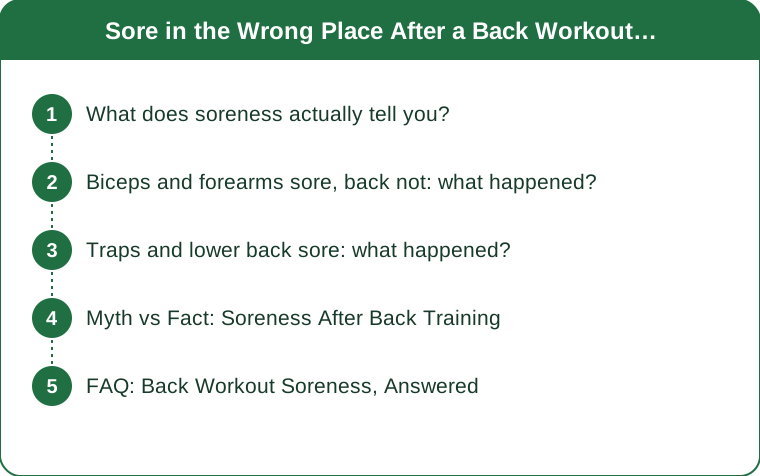
What does soreness actually tell you?
It tells you which tissue took the most unaccustomed load. Delayed onset muscle soreness follows unfamiliar work, especially eccentric loading, and it tends to be more pronounced in muscles doing something new to them. So the location of soreness is a reasonable indication of where the work landed relative to what those muscles are used to.
It is more informative early and less informative later. In the first few weeks of a movement, soreness distribution is a genuinely useful signal. After months of consistent training, soreness fades even when the same muscles are working hard, so its absence stops meaning anything.
It is not a measure of session quality. Plenty of highly effective sessions produce almost no soreness, and plenty of ineffective ones produce a lot. Chasing soreness as a goal leads to novelty for its own sake rather than progressive loading.
And it does not indicate damage in the ordinary sense. Normal soreness is diffuse, symmetrical, worst at 24 to 48 hours, and improves with gentle movement. Sharp pain, one-sided pain at a joint, pain that appeared during the session, or anything with numbness or weakness is a different category and worth a proper assessment. This is general information, not medical advice.
The useful question is comparative. Not was I sore, but was I more sore in my arms than my back - because that ratio is what tells you how the work was distributed.
Biceps and forearms sore, back not: what happened?
The arms initiated the pull and the back followed. In any rowing or pulling movement, the sequence should be shoulder blade first, then elbow. When the elbow bends before the shoulder blade retracts, the biceps become the prime mover and the lats become assistants.
The most common cause is starting the rep with the hands. The mental cue that changes it fastest is to think about driving the elbows back and down rather than pulling the handle - the handle follows the elbow rather than leading it.
A second cause is grip that is too tight and too thumb-dominant. Squeezing hard recruits the forearms and biceps and increases their contribution throughout. Using a false or hook grip, or thinking of the hands as hooks rather than clamps, reduces arm involvement noticeably.
A third cause is loading beyond what your back can control. When the target muscle cannot complete the rep, the body recruits whatever can, and in pulling that is nearly always the arms. Reducing the weight by 20 percent and slowing the eccentric frequently produces more back soreness than any cue.
Try single-arm work to diagnose it. A one-arm dumbbell row lets you feel the shoulder blade move independently, and most people find the sequencing much more obvious than in a two-arm movement.
And check the range at the start. Letting the shoulder blade fully protract at the bottom of a row or pulldown gives the lat somewhere to pull from. Starting from a partially retracted position removes the range where the back does most of its work.

Traps and lower back sore: what happened?
Upper trap soreness usually means shrugging. In pulldowns and rows, the shoulder blades should depress and retract - down and back. When they elevate instead, the upper traps do the work the lats were meant to do. It is extremely common in anyone with a desk job, because shrugged shoulders are already their resting position.
The fix is to actively set the shoulders down before each rep. Pull the shoulder blades down toward the back pockets, then pull. Some people find it easier to think of lengthening the neck.
Lower back soreness usually means the torso moved to finish the rep. In seated rows, leaning back at the end; in bent-over rows, extending the spine to complete the pull. Both convert an upper-body exercise into a hip and spine exercise.
Some lower back involvement is normal and expected in bent-over work - holding a hinged position is a genuine demand on the spinal erectors. The signal to act on is when the lower back is the most sore thing the next day, or when it is fatiguing before the back muscles you were targeting.
Reduce the load and fix the position before adding anything. A supported chest-supported row removes the spinal demand entirely and lets you feel what the upper back is actually doing, which makes it an excellent diagnostic exercise as well as a good training one.
And check whether it is a thoracic mobility limit. If you cannot achieve a good hinged position with a neutral spine, the lower back rounds to compensate - which is a mobility problem being expressed as a soreness pattern.
Myth vs Fact: Soreness After Back Training
Myth: If you are not sore, the session did not work. Fact: Soreness reflects unaccustomed load, not effectiveness. Trained muscles doing productive work often produce little soreness, and progress is measured by load, reps, and control over weeks - not by how you feel the next morning.
Myth: Feeling it in your biceps means your biceps are weak. Fact: It usually means sequencing - the arms initiated before the shoulder blades moved. Strong biceps do not prevent this and weak ones do not cause it; the order of the movement does.
Myth: You should stretch out soreness. Fact: Gentle movement generally helps more than static stretching, and there is no strong evidence that stretching meaningfully reduces delayed soreness. Light activity, sleep, and adequate protein are the reliable ones.
Myth: Lower back soreness after rows means you injured something. Fact: Diffuse muscular soreness in the spinal erectors after hinged work is normal, particularly when it is new to you. Sharp, localized, or one-sided pain - especially with numbness or leg symptoms - is a different thing and warrants assessment.
Myth: More soreness means you need more rest days. Fact: Duration and severity of soreness varies enormously between people and does not track well with recovery need. Performance in your next session is a much better guide than how tender you feel.
FAQ: Back Workout Soreness, Answered
Why are my biceps sore after a back workout?
Because the arms initiated the pull before the shoulder blades moved, making the biceps the prime mover. Think about driving the elbows back and down rather than pulling with the hands, loosen the grip, and reduce the load until the sequencing holds.
Why do I feel rows in my traps instead of my lats?
Usually because the shoulders are shrugging rather than the shoulder blades depressing. Actively set the shoulder blades down toward your back pockets before each rep - this is especially common in people who sit at a desk all day.
Is lower back soreness after rows normal?
Some is expected from holding a hinged position, which genuinely loads the spinal erectors. It becomes a signal when the lower back is the most sore area or fatigues before your target muscles - usually indicating torso movement to complete reps, or a thoracic mobility limitation.
Does soreness mean the workout was effective?
No. Soreness reflects unaccustomed load rather than training quality, and it fades with consistency even as the same muscles keep working hard. Judge progress by load, reps, and control over weeks instead.
TL;DR:
- Soreness location is a rough map of where the work landed - most informative in the first weeks of a movement, much less so later.
- Sore biceps and forearms mean the arms initiated the pull; drive the elbows back and down, loosen the grip, and reduce the load.
- Sore upper traps mean shrugging instead of depressing the shoulder blades - very common in desk workers.
- Sore lower back usually means the torso moved to complete reps, or a thoracic mobility limit is forcing compensation; chest-supported rows are an excellent diagnostic.
- Soreness is not a measure of session quality, and sharp, one-sided, or joint-line pain is a different category that deserves assessment.
The morning after tells you what the session did not. Read it as a distribution report rather than a grade, and each pattern points at one specific fix. This is general information, not medical advice.
Keep Reading
This article is for general informational and styling purposes only. Fit, sizing, and product availability may vary.