Why You Cannot Feel Your Lats, and the Specific Fixes That Work
Quick Answer: If you feel rows in your biceps and forearms instead of your back, the usual causes are gripping too hard, initiating with the arm rather than the shoulder blade, an overly heavy load, and a range of motion that never reaches a real stretch. Fix them in that order. Drop the weight by about 30%, start each rep by moving the shoulder blade before the elbow, and pause for a full second at the stretched position. Most people feel a clear difference within two or three sessions.
You have been training back consistently for months and your biceps are the sorest thing the next day.
That is not a genetics problem. It is four specific mechanical issues, and they are all fixable.

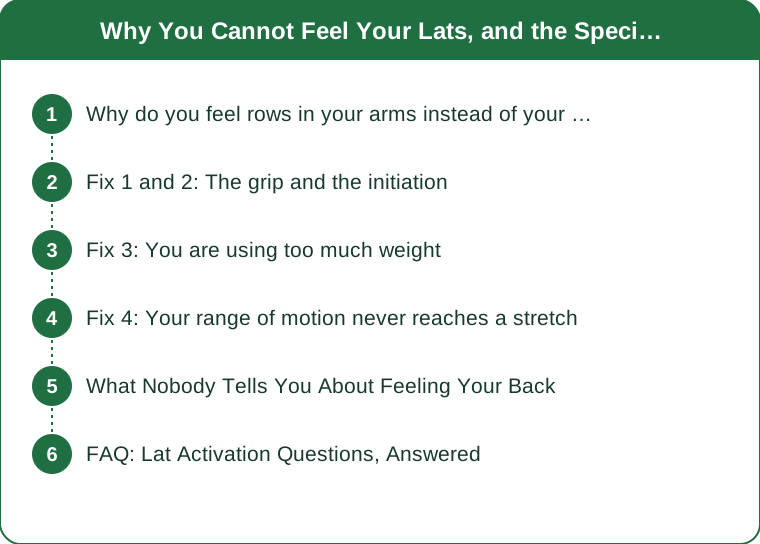
Why do you feel rows in your arms instead of your back?
Because your arms are the connection to the weight, and if nothing tells them to be passive they will do as much of the job as they can.
Every pulling movement travels through the hand, the forearm, and the biceps before it reaches the back. Those muscles are smaller and fatigue faster, but they are also earlier in the chain and more readily recruited - so they take the load first unless the movement is set up to prevent it.
The biceps also cross the elbow, and elbow flexion is a large part of what a row looks like from the outside. It is entirely possible to perform a movement that resembles a row while doing almost all the work at the elbow and almost none at the shoulder blade.
The lats attach at the upper arm and act to bring it down and back toward the body. That means the shoulder has to move for the lat to work. When people describe not feeling their back, the underlying pattern is usually a rep where the elbow bent and the shoulder blade barely moved at all.
Fix 1 and 2: The grip and the initiation
Loosen your grip
A hard grip recruits the forearm and biceps up the chain automatically.
Hold the bar or dumbbell just firmly enough that it will not slip - roughly half the tension you currently use. Some people find it helps to think of the hand as a hook rather than a clamp, with the fingers doing the holding and the palm staying relatively relaxed.
If your grip fails before your back does, straps are a legitimate tool rather than cheating. Their entire purpose is to remove grip as the limiting factor so the target muscle can be trained.
Start with the shoulder blade, not the elbow
This is the single most useful cue in this article. Before your elbow bends at all, pull your shoulder blade back and down - toward your opposite back pocket. Only then let the elbow follow.
Practice it without weight first. Hang from a bar or hold a light cable and perform only the shoulder blade movement, keeping your arms completely straight. That small range of motion - maybe two inches - is the part most people skip entirely, and it is where the back actually engages.
Fix 3: You are using too much weight
This is the least popular fix and frequently the correct one.
When a load is near your limit, your body recruits whatever is available to move it. Form degrades toward the pattern that produces the most force, which for pulling means more elbow flexion, more momentum, and more trunk movement.
Cut the weight by about 30% for three weeks. It will feel insultingly light on the first set. The purpose is not to train harder - it is to give your nervous system enough room to learn a movement pattern it currently cannot perform under load.
A useful benchmark: if you cannot pause for a full second at the top of a row with your shoulder blade retracted, the weight is too heavy for the purpose of building the connection.
Most people find they can return to close to their original load within about a month, but now doing it with the back. The strength was never the limitation; the pattern was.

Fix 4: Your range of motion never reaches a stretch
The lat produces its strongest sensation at the lengthened position, and most people cut that range short entirely.
At the bottom of a row or a pulldown, let your shoulder blade travel forward - allow it to protract, letting the arm reach further than feels natural. This is not rounding your back; your spine stays where it is while the shoulder blade slides.
That stretched position is where the lat is under the most tension, and training through a full stretch appears to be meaningfully more effective for hypertrophy than partial ranges.
Add a one-second pause there. Most people are moving too fast to reach it at all - they reverse direction the moment the weight starts to descend, which removes the most valuable part of the rep.
Combined with the shoulder-blade-first cue, this gives you a complete rep: reach and stretch at the bottom, shoulder blade back, then elbow, pause at the top.
What Nobody Tells You About Feeling Your Back
Single-arm work teaches the pattern faster than anything else. With one arm you can use the free hand to feel your own lat contracting, and you eliminate the stronger side compensating for the weaker one. If you are only going to change one thing, make it two weeks of single-arm rows.
Soreness is not the target. Feeling a muscle work during a set is useful feedback for learning a pattern, but next-day soreness is a poor indicator of whether training was effective. Plenty of highly effective back sessions produce very little soreness.
Pulldowns are often easier to learn on than rows. The seated position removes trunk stabilization from the equation, so more of your attention is available for the shoulder blade. Learn the pattern there, then transfer it.
Your posture outside the gym is part of this. Spending eight hours with rounded shoulders and a protracted scapula means the position you are asking for in the gym is unfamiliar to your body. Some people find the connection improves noticeably once they address desk setup.
It genuinely takes weeks, not sessions. The connection is a motor learning problem, and motor learning is repetition over time. Two or three weeks of deliberate light practice is the realistic timeline.
FAQ: Lat Activation Questions, Answered
Should I use straps?
If grip is failing before your back, yes. Straps remove the limiting factor so the target muscle can actually be trained to fatigue. Keep some grip work elsewhere in your program - deadlifts, carries - so grip strength still progresses.
Are pull-ups or rows better for learning this?
Rows, generally. Pull-ups require managing your whole bodyweight, which makes it much harder to control the shoulder blade deliberately. Build the pattern on supported rows and pulldowns, then take it to pull-ups.
Why do I feel it on one side but not the other?
Very common, and usually a combination of handedness and posture. Single-arm work is the direct fix - train the weaker side first, match the stronger side to its reps, and the asymmetry typically narrows over a couple of months.
Is mind-muscle connection actually real or is it broscience?
There is research supporting it - studies using internal focus cues have found increased muscle activation in the target muscle compared with external cues, particularly for smaller isolation work. For a large muscle like the lat, the practical value is mainly that the cue produces better positioning, which is measurable regardless. This is general information, not medical advice.
TL;DR:
- Feeling rows in your arms means the shoulder blade is not moving - the elbow is doing the whole rep.
- Loosen your grip. A hard grip recruits forearm and biceps automatically.
- Initiate with the shoulder blade, then let the elbow follow. Practice the two-inch movement with no weight first.
- Cut the load by 30% for three weeks. Heavy weight forces compensation; you cannot learn a pattern under it.
- Reach a real stretch at the bottom and pause a second. That is where the lat is under the most tension.
- Single-arm work teaches this faster than anything else, and pulldowns are easier to learn on than rows.
The connection is a motor learning problem, not a strength or genetics one. Two or three weeks of deliberately lighter, slower practice usually resolves what months of heavier training did not. This is general information, not medical advice.
Keep Reading
This article is for general informational and styling purposes only. Fit, sizing, and product availability may vary.