How Long Back Exercises Actually Take to Fix Desk Posture
Quick Answer: Most people notice subjective posture improvement within 4-6 weeks of consistent back and postural strengthening, but measurable structural changes in habitual posture tend to take 3-6 months of consistent work, not a quick fix.
Desk-job posture didn’t happen in a week, and it’s not going to reverse in one either — but the actual timeline is more encouraging than most people assume.

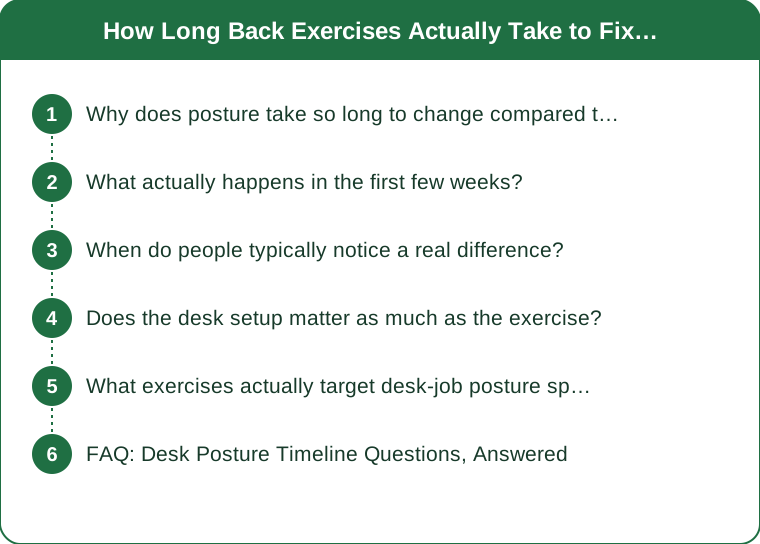
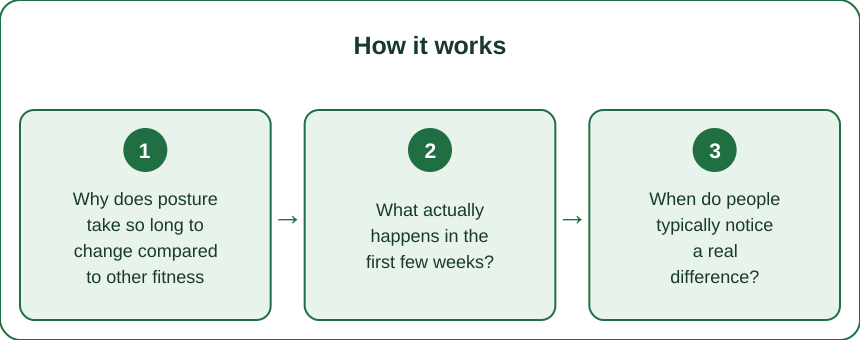
Why does posture take so long to change compared to other fitness goals?
Postural habits are deeply ingrained motor patterns built over years of repetition — sitting a certain way, thousands of times, for years. Retraining that pattern requires both strengthening weak muscles and un-learning the habitual position, which takes longer than pure strength gains alone.
This is different from, say, building visible arm definition, which is primarily a strength and muscle-growth process without the same ‘unlearning a years-long habit’ component.
What actually happens in the first few weeks?
Early on (weeks 1-4), most of what’s happening is neuromuscular — your brain and muscles are relearning to activate underused postural muscles (particularly the mid-back and rear shoulder muscles), even before visible or structural changes occur.
This is often felt as ‘awareness’ — noticing you’re slouching more often than before, which is actually a sign progress is happening, not a sign nothing’s working yet.
When do people typically notice a real difference?
Around the 6-8 week mark is commonly reported as when posture starts holding more naturally throughout the day without conscious correction, assuming consistent strengthening work 2-3 times per week.
By 3-6 months, more structural adaptations — genuine strength gains in the muscles that support upright posture — tend to make the new posture feel like the default rather than an effort.

Does the desk setup matter as much as the exercise?
Genuinely, yes — even a strong back can be undone by hours a day in a poorly set up workstation. Monitor height, chair support, and regular movement breaks work alongside exercise, not as an alternative to it.
A good rule some ergonomists suggest: a movement break of at least a minute or two every 30-45 minutes of sitting, regardless of how strong your back is.
What exercises actually target desk-job posture specifically?
Rows (band or dumbbell) and rear delt work target the upper back muscles that counteract forward-rounded shoulders from typing. Chest and hip flexor stretching address the tightened side of the equation — desk posture doesn’t just weaken the back, it also tightens the front.
Both sides — strengthening the back, stretching the front — matter for the full correction; focusing on only one side is a common incomplete approach.
FAQ: Desk Posture Timeline Questions, Answered
Can posture fully return to normal after years at a desk?
Many people see substantial improvement, though some structural changes (particularly if posture issues developed over many years) may not fully reverse — ‘substantial improvement’ is a realistic goal, ‘perfect’ isn’t guaranteed for everyone.
Is it too late to start if I’ve had bad posture for 10+ years?
No — research on postural exercise interventions shows meaningful improvement is possible at essentially any starting point, though the timeline may run longer than for someone with a shorter history.
Do posture correctors (wearable braces) speed this up?
They can provide helpful proprioceptive reminders short-term, but most physical therapists caution against relying on them long-term instead of building the actual muscular strength.
TL;DR:
- Subjective posture improvement often shows up within 4-6 weeks; structural change takes 3-6 months
- Early weeks are mostly neuromuscular relearning, even before visible change
- Workstation setup and movement breaks matter alongside exercise, not instead of it
- Both strengthening the back and stretching the front (chest, hip flexors) matter for full correction
This is general information, not medical advice — a physical therapist can assess posture issues tied to pain or injury.
Keep Reading
This article is for general informational and styling purposes only. Fit, sizing, and product availability may vary.