Why You Feel Back Exercises Mostly in Your Arms Instead of Your Lats
Quick Answer: Feeling back exercises mostly in your biceps and forearms instead of your lats almost always comes down to poor mind-muscle connection and grip-dominant pulling technique, not weak lats specifically — leading with the elbows instead of the hands, and consciously pre-activating the lats before pulling, fixes most cases.
It’s one of the most common frustrations in back training: you’re doing all the ‘right’ exercises, but your arms are burning out long before your back feels like it’s doing much work at all.

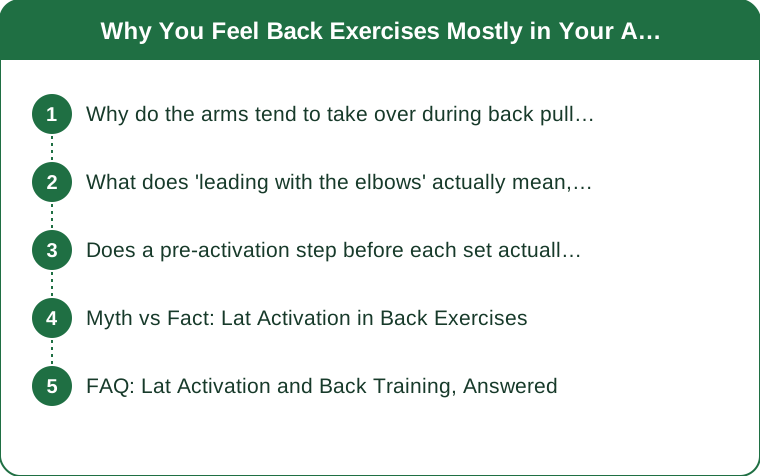
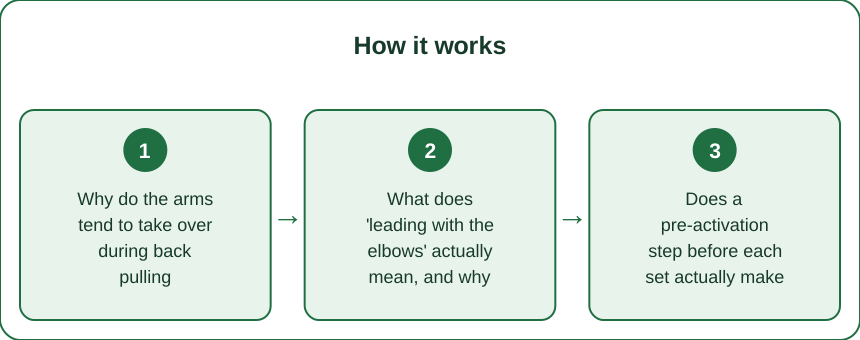
Why do the arms tend to take over during back pulling exercises?
The biceps and forearms are smaller, more easily recruited muscles that naturally want to dominate any pulling movement, especially when grip strength or arm strength outpaces someone’s ability to consciously activate the larger, less intuitively ‘felt’ lat muscles. This isn’t a sign of weak lats — it’s a sign that the nervous system hasn’t yet learned to prioritize them during the movement.
What does ‘leading with the elbows’ actually mean, and why does it help?
Leading with the elbows means initiating the pulling motion by driving your elbows down and back, rather than focusing on pulling the bar or handle toward you with your hands. This subtle mental cue shifts the movement’s initiation point away from the hands and forearms (which recruits more arm muscle) and toward the shoulder and back, which recruits more lat muscle.

Does a pre-activation step before each set actually make a measurable difference?
Yes — spending 10-15 seconds before a set doing a light lat activation (a gentle shoulder depression and slight pull-down sensation without weight) primes the mind-muscle connection for that muscle group, similar to how a brief glute activation before squats improves glute engagement during the actual lift. This small habit measurably improves lat engagement for many lifters within the very same session.
Myth vs Fact: Lat Activation in Back Exercises
Myth: If your arms are tired after a back workout, your back muscles got a good workout too. Fact: Arm fatigue and back muscle activation are separate — significant arm fatigue can actually indicate the back muscles were under-recruited relative to the arms.
Myth: A wider grip automatically engages the lats more. Fact: Grip width affects range of motion and muscle emphasis somewhat, but technique (elbow path, pulling initiation) has a bigger effect on lat activation than grip width alone.
FAQ: Lat Activation and Back Training, Answered
Should I use lighter weight while working on this mind-muscle connection?
Yes, temporarily — reducing weight while you build the elbow-leading pattern and pre-activation habit lets you focus on quality of movement before adding load back.
How long does it typically take to feel a real shift toward the lats?
Many people notice a difference within 2-3 weeks of deliberately practicing elbow-led pulling and pre-activation, though it varies by individual mind-muscle connection.
Are there specific exercises that make this easier to learn than others?
A straight-arm pulldown (keeping the elbow slightly bent but not bending it through the movement) isolates the lats more directly and is often used specifically to teach this activation pattern before returning to standard rows and pulldowns.
TL;DR:
- Arms dominating back exercises usually reflects a mind-muscle connection gap, not weak lats
- Leading with the elbows shifts the movement’s initiation away from grip-dominant pulling
- A brief pre-activation before each set improves lat engagement within the same session
- Feeling more in your back and less in your arms is a learnable skill, not fixed anatomy
Before assuming your back is just naturally weak, check whether your arms are simply doing the job your lats should be doing.
Keep Reading
This article is for general informational and styling purposes only. Fit, sizing, and product availability may vary.