Why a Stiff Upper Back Caps Your Pulling Strength
Quick Answer: Your shoulder blades need to move across a mobile ribcage to let the lats and mid-back work properly. If your thoracic spine is stiff - common with desk work - the shoulder blade cannot retract or upwardly rotate fully, so the arms and upper traps take over. Five to eight minutes of thoracic extension and rotation work before pulling usually changes what you feel in the very first set.
The weight has gone up. The feeling has not. Rows land in your biceps, pulldowns land in your forearms, and the mid-back you are trying to train stays quiet regardless of what you add to the bar.


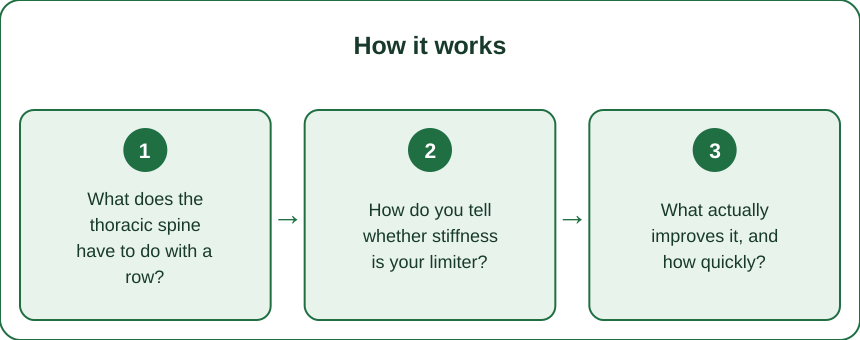
What does the thoracic spine have to do with a row?
Your shoulder blade does not sit on a joint the way most bones do - it floats on the back of your ribcage, held by muscle. So its movement depends entirely on the surface it slides across, and that surface is your thoracic ribcage.
When you row, the shoulder blade needs to retract - slide towards the spine - and rotate slightly. For that to happen fully, the thoracic spine has to be able to extend, which flattens the upper back slightly and gives the blade room to travel.
If the thoracic spine is stuck in flexion - the rounded position most of us spend the day in - three things follow:
- The blade cannot fully retract, because the curved ribcage is in the way
- The lats work through a shortened range, so they contribute less
- The body finds the movement elsewhere - usually elbow flexion, which is why you feel it in your biceps, and upper trap elevation, which is why your neck and shoulders get tight
That last point is the whole issue. Your body will complete the movement one way or another. If the intended muscles cannot reach their range, the substitutes will do the work, get stronger, and reinforce the pattern.
So you can absolutely add weight for six months. You will just be loading the substitution.
How do you tell whether stiffness is your limiter?
Four tests, none requiring equipment, all taking under a minute.
Test 1 - the wall test. Stand with heels, bottom, upper back, and head against a wall. Can you get all four points touching without your lower back arching away from the wall? If you have to arch or tuck your chin awkwardly, thoracic extension is limited.
Test 2 - seated rotation. Sit on a chair, cross your arms over your chest, and rotate as far as you can each way. Around 45 degrees each direction is a reasonable working range. Noticeably less, or a clear left-right difference, points at the thoracic spine.
Test 3 - overhead reach against a wall. Stand with your back flat against a wall and raise both arms overhead, keeping the low back flat. If your arms cannot reach the wall without your ribs flaring or your back arching, thoracic extension is limiting overhead range - and the same restriction limits pulling.
Test 4 - the retraction test. Stand, arms at your sides, and squeeze your shoulder blades together. Feel where the movement happens. If you feel your neck and upper traps engage, or your chest lift by arching the low back, the blades are not moving freely on the ribcage.
How to interpret it: if two or more tests are restricted and you feel rows in your arms rather than your back, mobility is very likely your limiter. If the tests are fine and you still cannot feel your back, the issue is more likely to be technique or motor control - which needs different work.
What actually improves it, and how quickly?
Thoracic mobility responds faster than most people expect - often within a couple of sessions for the immediate range, with lasting change over several weeks.
Do this before pulling sessions, 5 to 8 minutes:
Foam roller thoracic extensions. Roller across the upper back, hands supporting the head, extend back over it. Work in three positions - upper, mid, lower thoracic - 5 slow extensions each, breathing out as you extend. This is the highest-return drill here.
Open book rotations. Side-lying, knees bent, top arm rotating open towards the floor behind you. 8 each side, moving with the breath and pausing 2 seconds at the end.
Quadruped thoracic rotation. On hands and knees, one hand behind the head, rotate the elbow up towards the ceiling. 8 each side. More specific than the open book for rotation under load.
Wall slides. Forearms on a wall, slide upward keeping contact and keeping the ribs down. 10 reps. This connects the new range to shoulder blade movement, which is the point.
Then prime the pattern before your working sets:
Band pull-aparts, 15 reps, focusing on the blades moving rather than the arms.
Prone Y raises, 10 reps with no weight or a very light plate, which trains the lower trap that controls the blade.
Timeline to expect: immediate improvement in what you feel during the session, typically after the first time. Lasting range change over four to six weeks with three sessions a week. If nothing changes at all after a few weeks, get it assessed - some stiffness is structural rather than muscular. This is general information, not medical advice.

Myth vs Fact: Upper Back Stiffness and Pulling
Myth: If you cannot feel your back, you just need to concentrate harder. Fact: Mind-muscle connection helps only within the range you actually have. If the blade physically cannot retract, focus will not create the movement, and the substitution will continue regardless of how hard you concentrate.
Myth: Stretching your chest and lats is the fix. Fact: Helpful alongside, but not the main event. The restriction is usually in thoracic spine extension and rotation, not in the muscles at the front. Stretching pecs without addressing the spine tends to produce a small, temporary change.
Myth: You need more weight to make your back work. Fact: More weight amplifies whatever pattern you have. If the pattern is arms-and-upper-traps, heavier just means stronger arms and tighter traps. Fix the range first, then load it.
Myth: Foam rolling the upper back is dangerous. Fact: Rolling the thoracic spine is standard practice and generally well tolerated. Keep it above the bottom of the ribcage - do not roll the lower back, which is not built for extension over a roller.
Myth: Mobility work should be done after training, not before. Fact: For this specific problem, before is the point - you are creating the range you are about to use. Do the extension and rotation work in your warm-up, then prime the pattern with light band work, then lift.
How do you keep the range once you have it?
The reason this problem returns is that eight hours of desk work outvotes forty minutes in the gym. Maintenance has to happen outside the session.
Two positional resets a day, 60 seconds each. Stand up, hands behind your head, extend the upper back and breathe out. Or use a chair back to extend over. Twice a day is enough to interrupt the accumulation.
Change your desk position rather than perfecting it. No sitting position is good for eight hours. Movement between positions matters more than the ideal one, and a timer every 45 minutes does more than any chair.
Keep the pulling volume honest. Most desk workers need more pulling than pressing - something like a 2:1 ratio of rows and pulldowns to presses while catching up.
Train the position, not just the range. Mobility gives you access; strength keeps it. Prone Y and T raises, face pulls, and band pull-aparts train the muscles that hold the new position. Two or three sets, two or three times a week.
Recheck the wall test monthly. It takes ten seconds and it tells you whether you are holding the change or drifting back.
And re-set expectations about what a row should feel like. Once the range is there, a properly executed row feels like the muscles between your shoulder blades working and your arms simply connecting you to the weight. If your arms are still the loudest sensation, go back to the tests rather than adding another plate.
FAQ: Thoracic Mobility and Back Training Questions, Answered
How long before rows feel different?
Often within one session for the immediate feeling, because you have created range you can use straight away. Lasting change in resting posture and range typically takes four to six weeks of consistent work.
Is it my lats or my thoracic spine that is the problem?
Both can limit you, and they interact. The wall overhead reach test helps separate them: if your arms cannot reach the wall with a flat back, that is more likely thoracic; if they reach but with a strong stretch sensation down the side, that is more likely lat length.
Should I do mobility work on rest days too?
Yes, and it is often where the lasting change comes from. Five minutes on non-training days, plus two short positional resets during the working day, does more for maintenance than a longer session twice a week.
Can I fix this without a foam roller?
Yes. A rolled towel, the back of a firm chair, or a doorframe for rotation all work. The roller is convenient rather than essential - what matters is getting extension and rotation regularly.
TL;DR:
- Shoulder blades slide on the ribcage, so a stiff thoracic spine limits how far they can retract
- When range runs out, biceps and upper traps take over - which is why rows feel like arm work
- Test with the wall test, seated rotation, overhead reach, and a retraction check
- Do 5 to 8 minutes of foam roller extensions, open books, quadruped rotation, and wall slides before pulling
- Prime with band pull-aparts and prone Y raises, then lift - and expect a change in the first session
- Maintain with two 60-second resets a day, because desk hours outvote gym minutes
Adding weight to a movement your body cannot fully perform makes you better at the compensation. Create the range first and the same programme you have been running starts loading the muscles it was designed for.
Keep Reading
This article is for general informational and styling purposes only. Fit, sizing, and product availability may vary.