Why Your Back Rounds During Deadlifts (Even When You're Trying to Keep It Straight)
Quick Answer: Back rounding during deadlifts is most often caused by the bar drifting too far from the body or the hips rising faster than the chest at the start of the pull — not simply ‘forgetting’ to keep the back straight. Fixing bar path and lift-off sequencing solves it more reliably than a cue alone.
Every deadlift guide says ‘keep your back straight,’ and most lifters are actively trying to. Rounding still happens because the actual mechanical cause is usually somewhere else in the lift.

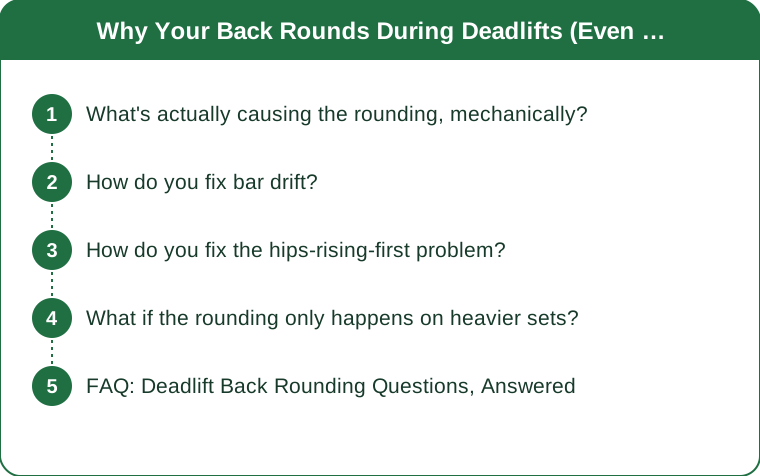
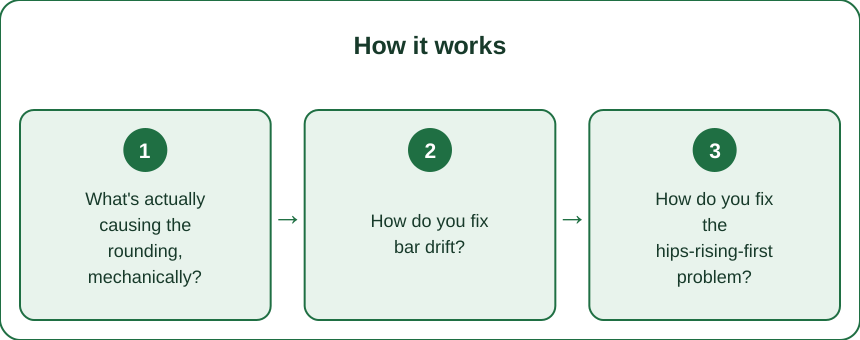
What’s actually causing the rounding, mechanically?
Bar drift away from the shins and thighs during the pull forces the lower back into more flexion to compensate for the increased lever arm. Hips rising before the chest at lift-off shifts the torso angle into a position where rounding becomes almost unavoidable, regardless of how hard you’re consciously trying to stay flat.
Both issues are positional, not effort-based — meaning ‘try harder to keep it straight’ doesn’t fix a bar path or sequencing problem.
How do you fix bar drift?
Keep the bar in contact with your shins on the way up, even if that means a small scrape on your shins through leggings or shin guards. A bar that drifts even an inch or two forward significantly increases lower back demand.
Starting with the bar closer to your shins in the setup position, not just trying to pull it closer mid-lift, prevents most drift before it starts.

How do you fix the hips-rising-first problem?
Cue ‘chest and hips rise together’ rather than focusing on the chest alone. Practicing the first few inches of the pull slowly, without weight, helps ingrain the correct sequencing before adding load back in.
A lighter warm-up set specifically focused on this sequencing, done deliberately slowly, trains the pattern more effectively than trying to fix it under a heavy top set.
What if the rounding only happens on heavier sets?
This usually means the form breaks down specifically under fatigue or near-maximal load, which points to either insufficient core bracing strength or working at a load beyond current technical capacity. Reducing weight slightly and rebuilding volume at a fully clean range often restores the pattern before adding load back.
Rounding that appears only above a certain weight threshold is a signal to build strength at the current clean-form weight before pushing higher, not to push through anyway.
FAQ: Deadlift Back Rounding Questions, Answered
Is some spinal flexion during a deadlift always dangerous?
Some natural, minor flexion happens even in well-executed lifts and isn’t inherently dangerous; the concern is significant, uncontrolled rounding under load, not the presence of any curve at all.
Should I record my deadlift form to check for rounding?
Yes — rounding is often hard to feel in the moment and much easier to spot on video from a side angle, especially in the bottom portion of the lift.
Does core bracing technique matter as much as bar path?
Yes — a strong 360-degree brace (not just ‘sucking in’) supports the spine through the full range and works together with correct bar path, rather than one substituting for the other.
TL;DR:
- Rounding is usually caused by bar drift or hips rising before the chest, not lack of effort
- Keep the bar in contact with your shins throughout the pull
- Cue and practice hips and chest rising together, especially in a slow warm-up set
- Rounding that appears only at heavier loads means dropping weight to rebuild clean form first
‘Keep your back straight’ is the right goal — bar path and lift-off sequencing are usually what actually gets you there.
Keep Reading
This article is for general informational and styling purposes only. Fit, sizing, and product availability may vary.