Can't Feel Your Lats in Pulldowns? Four Fixes, in Order
Quick Answer: Most people don’t feel their lats in pulldowns because they start the pull with the arms rather than with shoulder blade depression, grip too hard, use too much weight, and lean back too far. Fix them in that order. The single most effective change is initiating each rep by pulling the shoulder blades down before the elbows bend at all.
The lats are large and strong, which means when they aren’t recruited properly the smaller arm muscles fail first and you never reach the back at all.

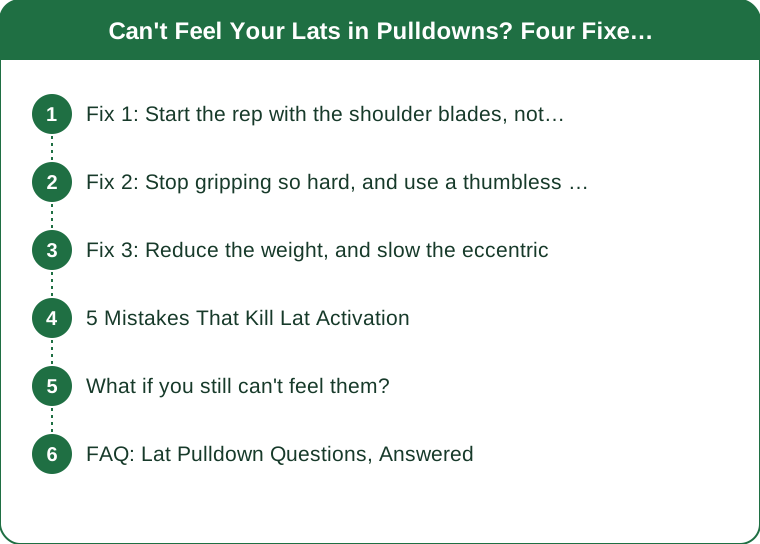
Fix 1: Start the rep with the shoulder blades, not the elbows
This is the fix that resolves the problem for most people, and it takes one session to learn.
The lats attach from the upper arm to the spine and pelvis, and one of their main actions is pulling the upper arm down and back. But the movement that recruits them first is scapular depression - pulling the shoulder blades down toward your back pockets.
What most people do: hang from the bar, then immediately bend the elbows. The biceps start the movement, and the lats join late or barely at all.
What to do instead:
- Start at full stretch, arms straight, shoulders up by your ears
- Pull your shoulder blades down first, with the arms still completely straight. You’ll move maybe 5cm. Your ribcage should lift slightly
- Then bend the elbows and complete the pull
Practise it isolated: do 3 sets of 8 “scapular pulldowns” with light weight - the shoulder blade movement only, no elbow bend. It feels like almost nothing is happening. Do them for two sessions before your normal pulldowns and the connection usually appears.
A useful cue during the full rep: think about driving your elbows down into your back pockets rather than pulling the bar down. Where your attention goes changes which muscle leads.
Fix 2: Stop gripping so hard, and use a thumbless grip
Grip pressure directly affects how much your forearms and biceps contribute.
Squeezing the bar hard recruits the forearm flexors strongly and encourages the whole arm to dominate the movement. It also means your grip fatigues before your back does, ending sets early.
What to change:
- Hook the fingers over the bar rather than gripping it, with the thumb on the same side as the fingers - a thumbless or false grip. This is safe on a pulldown, where the bar is in front of you and attached to a cable
- Reduce squeeze pressure to about 60% of what you’d naturally use
- Use straps if grip is the limiting factor. This isn’t cheating - grip is a separate quality, and letting it end your back sets means your back never trains to its limit
Why it works: with the arms functioning as hooks rather than as prime movers, the pull has to come from somewhere else. That somewhere else is the lats.
Bar choice matters too. A neutral grip (palms facing each other) or a narrower grip often produces a stronger lat sensation than a wide pronated grip, partly because it puts the shoulder in a more comfortable position through the range.
Fix 3: Reduce the weight, and slow the eccentric
The third fix, and the one people resist most.
Too much weight forces compensation - body swing, excessive lean, and arm-dominant pulling - all of which reduce lat involvement. A weight you can control is worth more than a weight you can move.
What to do:
- Drop the load by 20-30% for two to three weeks while you rebuild the pattern
- Take three seconds on the way up. The eccentric - the controlled return - is where a large part of the muscle-building stimulus is, and it’s what most people skip entirely by letting the bar snap back
- Pause for one second at the bottom of the pull, with the elbows down and the shoulder blades depressed. If you can’t hold that position for a second, the weight is too heavy
- Full stretch at the top. Let the shoulders rise toward the ears at the top of each rep. Cutting the range short at the top removes the stretched position, which is where lats do a lot of their growing
Rep range: 8-12 works well for this. Very heavy low-rep pulldowns tend to invite compensation before the pattern is established.
Expect the drop in weight to be temporary. Most people are back at their previous load within a month, with a completely different sensation and better results.

5 Mistakes That Kill Lat Activation
1. Leaning back too far. A slight lean - around 10-20 degrees - is fine and normal. A 45-degree lean turns the movement into a row, which is a fine exercise but not the one you selected. Keep the torso close to upright.
2. Pulling behind the neck. Puts the shoulder into extreme external rotation under load, which is a poor position for the joint and doesn’t increase lat recruitment. There’s no reason to do it.
3. Letting the bar rise fast. The return is half the exercise. Snapping back to the top wastes the eccentric entirely, and it’s the most common form of leaving results on the table.
4. Going too wide. Very wide grips shorten the range of motion and put the shoulder in a less advantageous position. Slightly wider than shoulder width is enough for most people - this is the mistake that persists longest because “wide grip for width” is repeated everywhere and isn’t well supported.
5. Not fixing the seat pad. If the thigh pad is loose, you’ll lift off the seat and use bodyweight to move the bar. Set it snug enough that you stay planted. It’s ten seconds and it changes the whole exercise.
What if you still can’t feel them?
A few things worth checking before concluding it’s not for you.
Try a different variation. Some people simply feel single-arm work far more clearly. A single-arm cable pulldown or a half-kneeling single-arm pulldown removes the side-to-side compensation and often produces the sensation immediately.
Do a pre-activation set. Straight-arm cable pulldowns, 2 sets of 15, before your pulldowns. It isolates the lats without any elbow bend and primes the connection.
Check your thoracic mobility. If you can’t get your arms fully overhead without arching your low back, you can’t reach the lat’s stretched position. A minute of thoracic extension over a foam roller before pulling often makes a visible difference.
Don’t over-index on feeling. Muscle sensation correlates loosely with actual growth. If your pulldown numbers are rising over months and your form is sound, you’re training your lats whether or not you get a dramatic burn. Some people never get a strong lat sensation and develop excellent backs anyway.
When to get it looked at: shoulder pain at the top of the movement, clicking with pain, or numbness in the arm. Those are worth a physiotherapist’s opinion rather than a form tweak. This is general information, not medical advice.
FAQ: Lat Pulldown Questions, Answered
Is a pull-up better than a pulldown?
Different, not strictly better. Pull-ups load more total bodyweight and train stability; pulldowns let you control the load precisely and train the eccentric, which is useful when you’re building the pattern. Both belong in a programme.
Should I use a wide grip for a wider back?
Grip width changes the emphasis somewhat but doesn’t determine width. Back width comes from lat development overall, and slightly-wider-than-shoulders lets you train through a fuller range with more load.
How many sets per week?
For most people, 10-16 hard sets per week across all back exercises produces good results. Pulldowns might be four to six of those.
Why do my forearms cramp?
Grip pressure and grip endurance. Reduce squeeze, try a thumbless grip, and use straps if it’s still the limiter. Train grip separately with hangs and carries if you want it stronger.
TL;DR:
- Start every rep by depressing the shoulder blades before any elbow bend
- Hook the fingers, drop grip pressure to about 60%, and use straps if grip fails first
- Cut the weight 20-30%, take three seconds on the return, and pause a second at the bottom
- Keep the torso near upright and the grip slightly wider than shoulders
- If sensation still won’t come, try single-arm work and a straight-arm pre-activation set
The lats aren’t weak. They’re just arriving late to a movement your arms started without them.
Keep Reading
This article is for general informational and styling purposes only. Fit, sizing, and product availability may vary.