Why You Can't Feel Your Lats During Pulldowns — and the Cue That Actually Fixes It
Quick Answer: Feeling pulldowns in your biceps or shoulders instead of your lats usually means the shoulder blades aren’t initiating the movement — starting each rep with a downward, back shoulder blade squeeze before the arms pull is the cue that redirects tension to the lats.
You’re doing the exercise correctly on paper — grip width, seat height, weight selection all fine — but the pull still seems to happen mostly in your arms. This is one of the most common lat pulldown complaints, and it almost always traces back to the same missing first step.

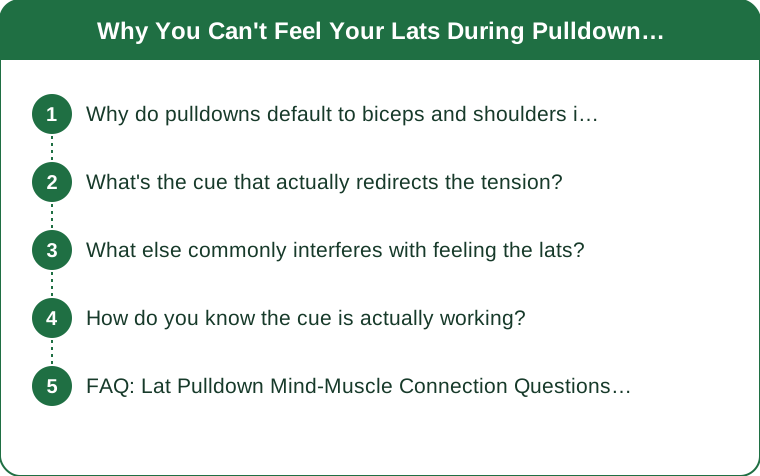
Why do pulldowns default to biceps and shoulders instead of lats?
Because the arms are mechanically eager to take over any pulling movement, and without a specific cue to engage the back first, the nervous system defaults to the muscles it’s more used to firing — biceps and front shoulders.
This isn’t a strength problem. It’s a sequencing problem: which muscle group initiates the movement matters as much as which muscles are technically involved.
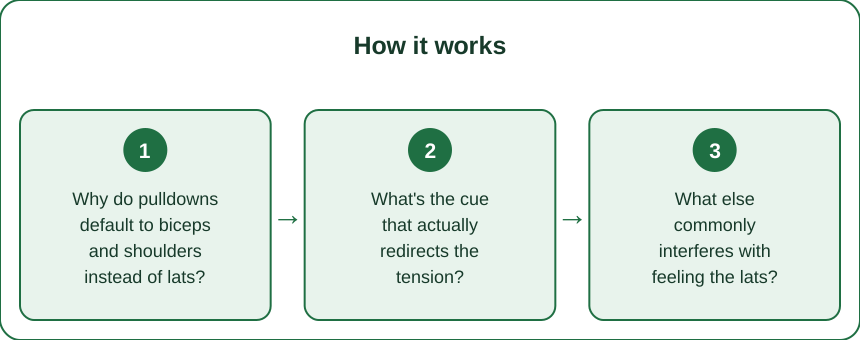
What’s the cue that actually redirects the tension?
Before pulling the bar down at all, squeeze your shoulder blades down and back, as if trying to tuck them into your back pockets — hold that position for a beat, then pull the bar down while maintaining that shoulder blade position throughout.
This pre-engagement step, done every single rep, is what shifts the initiating muscle group from arms to back. Skipping it and just pulling with the arms first is the most common reason lats stay quiet.

What else commonly interferes with feeling the lats?
Too much weight is a frequent culprit — if the load requires momentum or arm-dominant compensation just to move the bar, form breaks down before the lats get a chance to do the work.
Pulling to the wrong spot (too high toward the chin instead of to the upper chest) can also shift emphasis away from the lats toward the shoulders and upper traps.
How do you know the cue is actually working?
You should feel a stretch through the sides of your back at the top of the movement, and a squeezing sensation through the same area at the bottom — if you only feel forearm and bicep fatigue with no back sensation at all, the shoulder blade cue likely isn’t being maintained through the full rep.
Dropping the weight significantly to practice the cue in isolation for a few sessions is a reasonable, common approach before returning to your normal working weight.
FAQ: Lat Pulldown Mind-Muscle Connection Questions, Answered
Is it normal to need to drop weight significantly to feel this cue?
Yes — many people need a meaningful weight reduction, sometimes 30-50%, when first learning to initiate with the shoulder blades rather than the arms.
Should grip width change how much you feel your lats?
Grip width affects emphasis somewhat, but shoulder blade initiation matters more for overall lat engagement than grip width alone — fixing the cue first, then adjusting grip, is a more effective order.
How long does it typically take to build this mind-muscle connection?
Many people notice improved back engagement within 2-4 weeks of consistently practicing the shoulder blade cue, though it varies by individual experience with resistance training.
TL;DR:
- Arms default to initiating pulldowns unless the back is specifically cued first
- Squeeze shoulder blades down and back before pulling, every single rep
- Too much weight or pulling too high toward the chin also shifts tension away from the lats
- Drop weight temporarily to practice the cue in isolation if it’s not landing yet
The missing piece usually isn’t more weight or a different grip — it’s which muscle group gets the signal to move first.
Keep Reading
This article is for general informational and styling purposes only. Fit, sizing, and product availability may vary.