Scapular Winging: What That Shoulder Blade Sticking Out Actually Means
Quick Answer: A shoulder blade that lifts away from the ribcage - especially during a push-up or a wall press - usually means the serratus anterior isn’t holding it down against the rib cage. In most people this is a control and strength issue that responds to 6-10 weeks of targeted work. Winging that appeared suddenly, came with numbness, or followed an injury is a different situation and needs a clinician.
You catch it in a changing room mirror or a workout video: one shoulder blade sitting flat, the other lifting off like a small fin. Here’s what’s going on underneath.

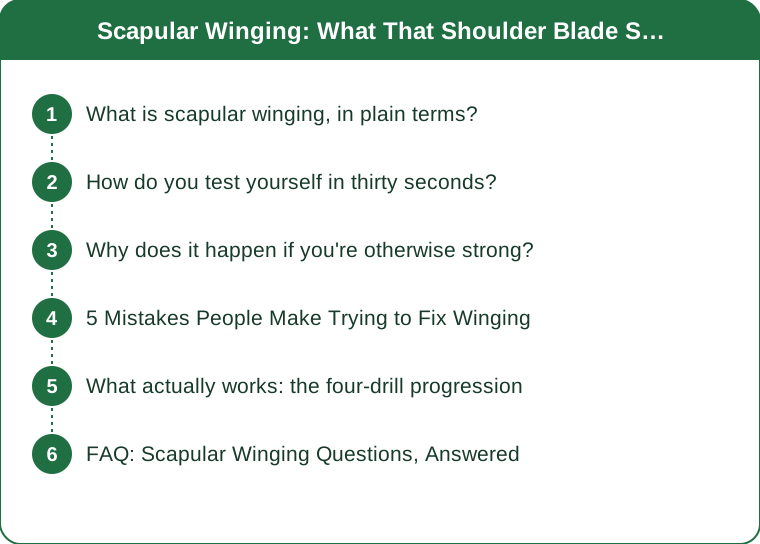
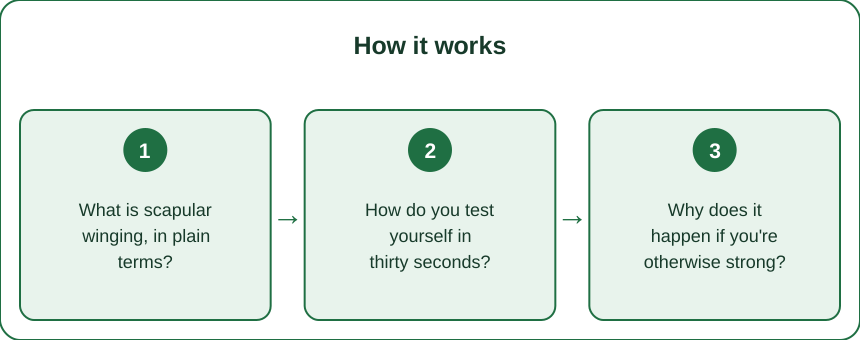
What is scapular winging, in plain terms?
Your shoulder blade doesn’t attach to your skeleton the way most bones do. It floats on the back of the ribcage, held in position entirely by muscle.
The serratus anterior is the muscle doing most of that holding. It wraps from the ribs around to the inner edge of the shoulder blade and pulls it flat against the ribcage. When it fires properly, the blade glides. When it doesn’t, the inner edge lifts - that’s the wing.
The rhomboids and lower trapezius are the other players. Lower trap holds the blade down; rhomboids pull it toward the spine; serratus holds it flat and rotates it upward as your arm goes overhead. Winging usually means the serratus is losing the argument.
Two versions are worth telling apart:
- Postural or functional winging - shows up only under load or in specific positions, both sides may do it, and it improves as you build control. This is the common one.
- Neurological winging - typically one side, often pronounced at rest, and traces to the long thoracic nerve rather than the muscle. It frequently appears after an illness, a fall, or surgery.
The practical distinction: if it appeared gradually and only shows during a push-up, that’s the first kind. If it appeared over days, involves weakness reaching overhead, or came with pain and numbness, get it looked at. This is general information, not medical advice.
How do you test yourself in thirty seconds?
Three checks, no equipment, and you’ll want a phone camera or a friend.
1. The wall press. Stand an arm’s length from a wall, hands flat at shoulder height. Lean in slowly, like a standing push-up, then push back out. Film your upper back. The blades should stay flat throughout and glide outward at the top of the press. A lifting inner edge on the way down is the classic finding.
2. The push-up plus. From a normal push-up top position, push a little further - protract, letting your upper back round slightly. Most people with winging can’t produce this last inch at all, which is diagnostic in itself. If nothing moves, your serratus isn’t in the conversation.
3. The overhead reach. Raise both arms straight overhead slowly. The blades should rotate upward smoothly. If one shrugs early, stalls, or the inner border pops, that’s the same story showing up in a different position.
Record all three from behind. The comparison between sides is more informative than any single view - almost everyone has a dominant-side difference, and you’re looking for a difference that’s obvious rather than subtle.
Why does it happen if you’re otherwise strong?
Because the serratus is easy to skip and hard to notice skipping.
Most upper-body training loads the blade retractors and neglects protraction. Rows, pulldowns, pull-ups, face pulls - all excellent, all pulling the shoulder blade toward the spine. Almost nothing in a standard programme trains the muscle that holds it flat against the ribs, so the imbalance builds quietly over years of otherwise-good training.
Desk posture compounds it. Sitting with rounded shoulders parks the blade in a protracted position without any active work, so the muscle sits shortened and unloaded for eight hours. Shortened plus unloaded is a reliable recipe for weak.
Breathing pattern matters more than most people expect. The serratus attaches to the ribs and works with the ribcage. Shallow upper-chest breathing changes rib position, which changes the base the shoulder blade sits on.
And bench pressing hides it. The bench supports your upper back, which means the serratus doesn’t have to hold anything. You can press respectable weight with a serratus that barely functions - it only shows up the moment your torso has to stabilise itself, which is why push-ups reveal it and bench press doesn’t.

5 Mistakes People Make Trying to Fix Winging
Mistake 1: Doing more rows. This is the intuitive move and it’s the wrong direction. Rows train retraction; winging is a protraction and upward-rotation problem. Adding rows can make the imbalance slightly worse.
Mistake 2: Stretching the chest and calling it done. A tight pec minor genuinely contributes by tipping the blade forward, and stretching it helps - but stretching alone doesn’t build the muscle that has to hold the new position. Stretch and then load, in that order, same session.
Mistake 3: Going straight to the hardest exercise. Handstand work and full push-up-plus reps from the floor are too much load for a muscle that can’t produce the movement unloaded. Start at the wall, where the load is a fraction of bodyweight and you can actually feel the target.
Mistake 4: Chasing the burn instead of the position. Serratus work done wrong just recruits the upper trap and neck - you’ll feel plenty and change nothing. If your neck is doing the work, drop the range and the load until it isn’t.
Mistake 5: Quitting at three weeks. Motor control changes come faster than strength changes, but the visible difference in blade position generally takes 6-10 weeks of consistent work, done 3-4 times a week. Three weeks feels like nothing is happening precisely when things are starting to happen.
What actually works: the four-drill progression
Run these in order. Move on when the current one is easy and clean, not on a schedule.
1. Wall slides with a towel (weeks 1-2). Forearms on a wall, towel between forearms and wall, slide up while pressing lightly into the wall. 3 sets of 10, slow, with a 2-second pause at the top. The press is the whole point - it’s what turns on the serratus.
2. Push-up plus at an incline (weeks 2-4). Hands on a bench or counter. Full push-up, then at the top push an extra inch so the upper back rounds slightly. 3 sets of 8-12. Lower the incline as it gets easy.
3. Bear crawl holds (weeks 4-6). On hands and knees, knees an inch off the floor, upper back actively pushed away from the floor. 3 holds of 20-30 seconds. This is protraction under real load with a stable spine, and it transfers well.
4. Loaded carries overhead (weeks 6+). A single light dumbbell or kettlebell held straight overhead, walking 20-30 metres. 3-4 trips per side. Upward rotation under load, which is the endpoint you’re building toward.
Add pec minor work throughout: a doorway stretch at a low arm angle, 30 seconds each side, before the drills rather than after.
Frequency beats intensity here. Four short sessions a week beats one long one, because you’re rebuilding a movement habit, not just tissue.
FAQ: Scapular Winging Questions, Answered
Is winging dangerous?
Functional winging isn’t dangerous in itself, but it changes how the shoulder joint sits under load and is associated with impingement-type shoulder pain over time. That’s the reason to address it rather than any acute risk.
Can I still train upper body while fixing it?
Yes. Keep training, but add the drills before your main work rather than after, while you’re fresh, and pull back on heavy overhead pressing until the wall press looks clean.
Why is only one side winging?
Side-to-side asymmetry is normal and usually reflects dominance, carrying habits, or an old injury you’ve stopped thinking about. Pronounced one-sided winging that appeared quickly is the version worth having assessed.
How long until I can see a difference in the mirror?
Control improves in 2-3 weeks; visible resting position typically takes 6-10 weeks of consistent work. Film the wall press every two weeks - the video shows change before the mirror does.
TL;DR:
- Winging usually means the serratus anterior isn’t holding the shoulder blade flat against the ribs
- Test with a wall press, a push-up plus, and a slow overhead reach - film it from behind
- More rows won’t fix it; the missing movement is protraction and upward rotation
- Progress wall slides to incline push-up plus to bear crawls to overhead carries
- Expect 6-10 weeks of 3-4 sessions a week for a visible change
A shoulder blade that won’t stay flat is a muscle that never got asked to do its job. Ask it four times a week and it answers.
Keep Reading
This article is for general informational and styling purposes only. Fit, sizing, and product availability may vary.