Why Does Your Back Crack During Rows and Pull-Ups? Should You Worry?
Quick Answer: Back cracking during rows or pull-ups is almost always gas bubbles releasing in the joint capsule (cavitation) as your shoulder blades and spine move through a fuller range of motion — it’s typically harmless unless paired with pain, swelling, or a specific injury moment.
You pull the bar down or row the weight back, and there it is — a distinct pop between your shoulder blades. It’s startling the first few times, but it’s rarely the warning sign it sounds like.

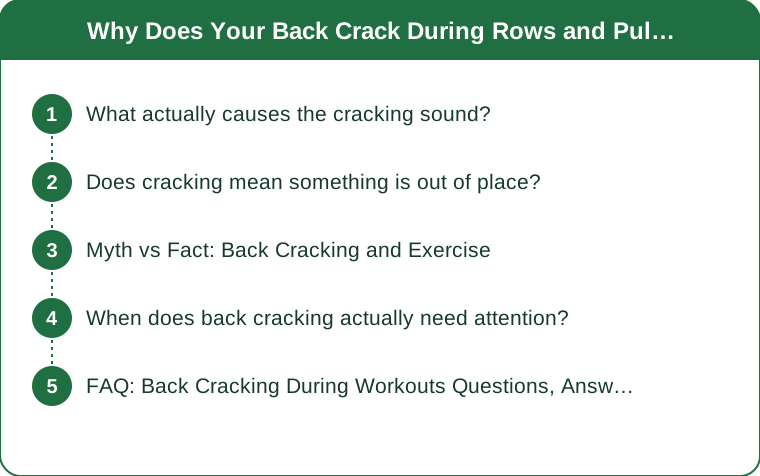
What actually causes the cracking sound?
Most back cracking is cavitation — tiny gas bubbles (mostly nitrogen) forming and collapsing in the fluid that lubricates your joints as they move through range they don’t normally hit in daily life. Rows and pull-ups both push your thoracic spine and shoulder blades through exactly that kind of range.
This is the same mechanism behind knuckle-cracking, and research hasn’t linked it to joint damage. It tends to happen more in people who sit a lot, since their joints simply aren’t used to moving that far.
Does cracking mean something is out of place?
No — this is one of the most persistent myths in fitness. A joint ‘popping back into place’ is a different (and much rarer) event, usually accompanied by an obvious shift in position and a change in how the joint feels, not a light, repeatable crack with normal training.
If your back cracks in roughly the same spot every session and nothing else changes, that’s a consistent, unremarkable pattern — not a sign your spine is misaligned.

Myth vs Fact: Back Cracking and Exercise
Myth: Cracking joints causes arthritis over time. Fact: Long-term studies on habitual knuckle-crackers found no increased arthritis rate — the same logic extends to incidental joint cracking during training.
Myth: You should stretch harder to make the cracking stop. Fact: Forcing extra range specifically to crack a joint isn’t necessary and can occasionally aggravate a joint that’s genuinely irritated — let it happen naturally within your normal exercise range.
Myth: A silent back means better form than a cracking one. Fact: Cracking frequency has no established link to form quality — plenty of people with excellent technique crack consistently, and plenty with poor technique never do.
When does back cracking actually need attention?
Get it checked if the crack is paired with sharp pain, swelling, or a noticeable loss of strength or motion right after it happens, or if it started suddenly after a specific incident (a fall, an awkward lift) rather than being a longstanding pattern.
A useful rule: if you can point to the exact moment something changed and it hurts, treat it differently than a crack that’s simply been part of your normal training for months.
FAQ: Back Cracking During Workouts Questions, Answered
Is it bad to crack your back on purpose before a workout?
Occasional self-mobilization isn’t inherently harmful, but there’s no proven benefit either — it’s more habit than necessity for most people.
Why does my back crack more on some days than others?
Hydration, how much you’ve been sitting, and how much range your recent training has covered can all shift how much gas has built up in the joint fluid, changing how often it releases.
Should I stop rowing if my back cracks every single set?
Not unless it’s paired with pain — a consistent, painless crack pattern during rows is common and not a reason to stop the exercise. This is general information, not medical advice.
TL;DR:
- Back cracking during rows/pull-ups is usually gas release (cavitation), not joints shifting
- No link between habitual joint cracking and arthritis in long-term research
- A crack with pain, swelling, or sudden onset after an incident deserves a professional look
- Consistent, painless cracking during your normal training range is not a red flag
This is general information, not medical advice — persistent pain alongside the sound is the actual signal to watch for.
Keep Reading
This article is for general informational and styling purposes only. Fit, sizing, and product availability may vary.